A Neighbourhood Walk with Three Questions
A neighbourhood walk with three questions helps you notice pauses, attention, and boundaries—and see how ordinary routes shape a sense of belonging.
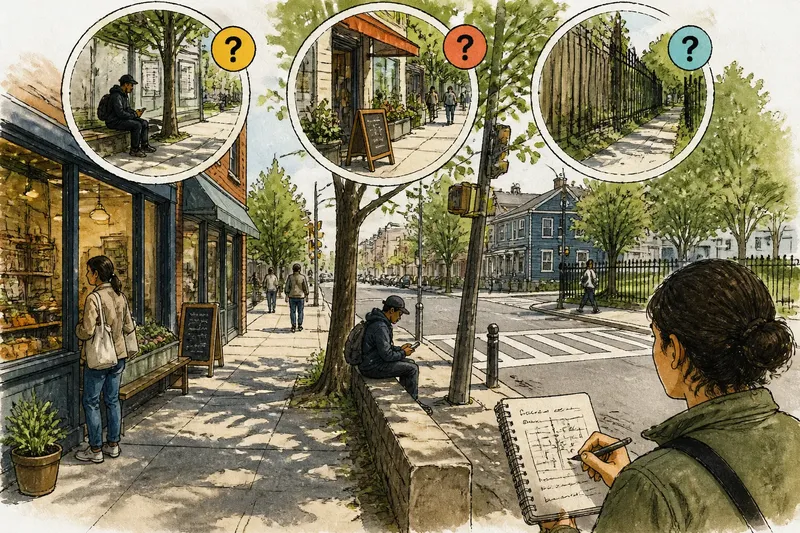
A neighbourhood walk with three questions can reveal how an ordinary route invites people in, holds their attention, or quietly sends them elsewhere. Walk a familiar block and ask: Where do people pause? What draws the eye? Which edges connect the route, and which divide it?
These questions turn a stroll into a place-reading exercise without turning neighbors into subjects of a study. The aim is not to judge a street by a single visit or decide what it should become. It is to notice the small arrangements—shade, storefronts, crossings, fences, doorways—that shape how a shared place feels to move through.
Start with a familiar route
Choose a route you already know, perhaps from home to a corner store, a bus stop, a library, or a small public square. Familiarity helps you spot details that usually slip past. If the route is new, keep it short and stay on public paths.
Go at a time that lets you walk comfortably, and leave room for the place to surprise you. A weekday morning may feel different from an evening or a weekend, but there is no need to compare every possible hour. This is a focused walk, not a survey. A pocket notebook or a notes app is enough; a simple map can help you mark where observations occur.
Keep your attention on the setting rather than identifying individuals. Notice broad patterns—a doorway used for waiting, a busy crossing, a shaded stretch—without photographing people or recording personal details. If someone speaks with you, listen naturally, but do not treat a passing conversation as a representative verdict on the neighborhood.
Where do people pause?
A pause can be brief: someone stops to check a phone, waits for a companion, looks into a window, or takes a breath in the shade. Look for places where movement slows, then ask what the surroundings make possible. A low wall might offer a place to lean; a bus shelter might gather people who have no choice but to wait; a shop entrance might create a moment of welcome or a pinch point.
Notice the difference between a pause that seems chosen and one imposed by the route. A person lingering near a public noticeboard may be reading, while a cluster at a signal may simply be waiting for a safe crossing. The point is not to infer anyone’s intentions with certainty. It is to record what the place affords and what seems to prompt the pause.
Pay attention to who can pause comfortably. Is there a dry, sheltered spot, or only a narrow edge beside traffic? Can someone stop without blocking a doorway or path? Does the route offer several places to rest, or does every pause depend on entering a business? These details help distinguish a street that is merely passable from one that leaves room for people to be present.
Imagine you take a familiar walk past a small grocery and notice people stopping near its broad front window, while the opposite side of the block has no shelter or place to lean. You might jot down “window, shade, doorway traffic” rather than assume why anyone stopped. On a later walk, you could notice whether the pattern changes when the store is closed or the sun shifts.
What draws attention?
Let your gaze travel as if you were arriving for the first time. What catches it: a bright mural, a cluster of trees, a bakery’s open door, a community bulletin board, or the movement of traffic? Then ask what makes that feature visible. Color, sound, scent, an open view, or the shape of the path may be doing the work.
Attention can come from more than a striking object. A row of front steps may show where everyday life meets the sidewalk. A public noticeboard may signal that local information belongs in the street, not only online. A blank wall can make a stretch feel less connected, though its meaning depends on what lies nearby and how people use the route.
Try separating what you see from what you think it means. “Three shop doors face the sidewalk” is an observation. “This block welcomes everyone” is a conclusion that would need more context. A walk offers clues, not a complete account of how residents experience a place.
Notice also what competes for attention. A sign may be hard to read from the sidewalk, or a tree canopy may make a crossing difficult to see. A busy corner can feel lively to one walker and overwhelming to another. You need not decide which feeling is correct; record the features that might help explain the difference.
Which edges connect or divide?
Edges are the boundaries and transitions along a route: a fence beside a park, a row of storefronts, a change from sidewalk to plaza, a driveway cutting across the walking path, or a wall between homes and a public space. Some edges guide movement or create a sense of enclosure. Others interrupt a route, narrow it, or make a place feel inaccessible.
Look for transitions as well as barriers. Does a path continue clearly from the sidewalk into a park? Can you see where a public space begins? Does a low fence mark a boundary while still allowing people to look through and hear one another? At a busy road, a crosswalk may join two sides on a map while the traffic, turning lanes, or long wait make the connection feel weak on foot.
Do not treat every boundary as a problem. A fence may protect a garden, give a playground a clear edge, or mark private space. The useful question is what the edge does for movement and encounter. Does it offer a passage, a view, or a place to stop? Does it make someone detour, guess where the entrance is, or abandon the route?
Edges can change the social character of a walk. A row of active doorways gives a passerby glimpses of ordinary neighborhood activity, while a long blank wall offers fewer signs of what is happening beyond it. Yet quiet stretches can be valuable too. Reading the sequence matters: a closed edge beside an open square may feel very different from the same wall extending for the whole block.
Reading the walk?
How long should the walk be?
Choose a route short enough to hold in mind, such as one block or a loop around a nearby shared space. The useful length is one that lets you notice changes rather than hurry to cover ground.
Should I take notes or photos?
Brief notes are often enough: record a location and a visible detail, such as “north corner, no shade near the crossing.” Photos of buildings or landscape features may help you remember a view, but avoid capturing identifiable people without their permission.
What if nobody is outside?
Record that the route was quiet at that time, then focus on features that remain visible, such as entrances, seating, lighting, and sightlines. A quiet walk cannot tell you whether a place is usually empty or simply active at another hour.
Can one walk tell me what residents need?
No single walk can establish what a neighborhood needs or how everyone feels. It can help you form sharper questions for a local conversation, a community meeting, or a later visit at a different time.
Turn observations into questions
After the walk, read your notes as a sequence. Where could you pause? What held your attention? At which edge did the route feel easy to follow, and where did it become uncertain? A place may offer a comfortable pause but little visual interest, or draw the eye while making the next crossing awkward. The three questions work together, but they do not need to produce one overall verdict.
Keep a distinction between observation, interpretation, and question. For instance:
- Observation: A sidewalk narrows beside a fence.
- Interpretation: Two people might have difficulty passing comfortably.
- Question: Is there another accessible route to the park entrance?
This small discipline keeps a vivid impression from becoming an unsupported claim. It also makes notes more useful if you share them with a neighborhood association, a public-space group, or a local accessibility committee. Describe the place and the route, then invite others to add what they know.
Pay attention to the limits of your own route. A walk from a nearby home may reveal how one person encounters the street, not how children, older neighbors, wheelchair users, transit riders, or people working late experience it. If a specific change is under discussion, ask residents with relevant experience and consult the local agency responsible for the space. Their knowledge can correct what a passerby cannot see.
Repeat with a purpose
A second walk can answer a particular question rather than repeat the whole exercise. If you noticed a difficult transition, return to see whether the entrance is clearer from the other direction. If shade shaped the pauses, revisit when the light falls differently. If a community board caught your eye, notice whether it is visible from the path and whether its information appears current.
Keep the comparison modest. Note the time and conditions that matter to your question, then look for what changed and what stayed the same. A closed café, a delivery truck, or a local event can alter the feel of a block. That variation is not a flaw in the walk; it is a reminder that neighborhood life moves through changing routines.
A neighbourhood walk with three questions is most useful when it leaves you more curious, not more certain. It can show where a route makes room for lingering, what gives a shared place its pull, and where a boundary interrupts connection. On your next ordinary walk, choose one detail to notice closely—and let the street offer the next question.